

Using quantified risk to prioritize vulnerability remediation beyond basic patching
Stop ranking patches by CVSS severity and start ranking them by the financial loss each one actually puts on the table.


Patching by CVSS score feels responsible and, for years, it was the best heuristic most teams had. But the score is not telling you what to fix first. It tells you which vulnerabilities are technically severe, which is a different question from which ones could cost you the most money. I have watched security teams burn a quarter chasing every critical in the queue and still leave their largest financial exposure untouched, because the thing that would actually sink them scored a 7.5 and got buried under a hundred 9.8s. The fix is to rank vulnerability remediation by calculated financial loss exposure instead of raw severity, which reorders the same patch backlog around what could actually hurt you.
This is not an argument against patching, however. It’s an argument against letting a 0-to-10 severity score stand in for a risk decision it was never built to make.
Why CVSS was never a prioritization tool
CVSS measures the technical characteristics of a vulnerability: how easy it is to exploit, what access it grants, what it does to confidentiality, integrity, and availability. That’s useful. But the score says nothing about whether the affected system holds anything you would miss, what a compromise would actually cost you, or how likely that system is to be hit in the first place. FIRST, the body that maintains the standard, says this directly — the base score is a measure of severity, not risk, and it is not meant to be used on its own to prioritize.
Note that the gap is not academic. The CISA and NIST guidance on the Known Exploited Vulnerabilities catalog, as well as the Exploit Prediction Scoring System (EPSS), exist precisely because a high CVSS score is a poor predictor of whether a vulnerability will be exploited in the wild. Most published CVEs with a critical rating are never weaponized. A small subset is, and that subset is what drives real loss. If you are working the queue top-down by severity, you are spending the same effort on the 95% that will never touch your business as on the few percent that could end your quarter.
So you end up with two backlogs that look identical on a dashboard and behave nothing alike. One is full of severe-but-irrelevant findings on systems with no material exposure. The other is a handful of moderate-scored vulnerabilities sitting on the systems that, if they go down, take revenue with them. CVSS sorts those two backlogs into the same pile.
What financial loss exposure actually measures
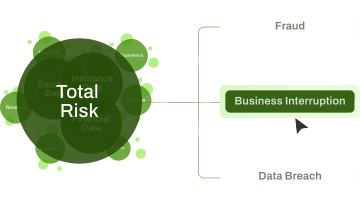
Quantified risk asks a different question for each vulnerability: if this gets exploited, what does it cost, and how likely is that? You take the system the vulnerability sits on, estimate the loss if it is compromised — business interruption, extortion, data breach, fraud, recovery — and weight that by the probability of exploitation. The output is a dollar figure of expected loss, not a 0-to-10 abstraction. That number is what you sort on.
The methodology underneath this is not new. FAIR (Factor Analysis of Information Risk) has been formalizing loss frequency and loss magnitude into defensible numbers for years, and it is the bridge between how a security team thinks about controls and how a CFO thinks about exposure. Applied to a patch queue, it reorders everything. A vulnerability on a segmented test box with no sensitive data and no path to anything that matters might be a CVSS 9.8 and a near-zero expected loss. A CVSS 7.1 on the system that runs your billing might carry seven figures of probable loss behind it, and the model puts it on top.
Our own claims data backs up the frequency-versus-severity split. According to Resilience claims data from March 2021 through February 2026, ransomware accounted for 12% of manufacturing claims but 90% of incurred losses in that sector, a small share of incidents driving almost all of the cost. The same analysis found misconfigured MFA, a single category of control failure, among the most expensive points of failure in the portfolio. The pattern is consistent: loss concentrates. A prioritization method that treats every severe finding as equally urgent is optimizing against the wrong distribution.
How to reorder a patch queue by exposure
You do not need to model every CVE to get the benefit. Most organizations have a small number of systems that carry the bulk of their financial exposure, and the work is to find those first. Start by mapping which systems would actually generate a material loss if compromised, like the billing platform, the customer data store, and the systems whose downtime stops revenue. That set is usually shorter than people expect.
Then weight each open vulnerability by the exposure of the system it sits on and the likelihood it gets exploited, pulling exploitation signals from sources like the KEV catalog and EPSS, the Exploit Prediction Scoring System, which estimates the probability a given CVE will be exploited in the next 30 days. A moderate-severity vulnerability on a high-exposure system with a rising EPSS score outranks a critical-severity finding on a system that holds nothing and faces nobody.
If you have already moved your board reporting away from the heat map and toward quantified financial models, this is the same logic pushed down to the operational layer. The board conversation and the patch queue should run on the same currency. When they do, quantifying cyber risk for strategic alignment stops being a reporting exercise and starts driving where your team spends Tuesday morning.
Where this approach has limits
I will name what this does not do, because the quant case is easy to oversell. A loss model is only as good as the inputs, and the inputs are estimates. You are putting probability ranges on exploitation and dollar ranges on impact, and both have error bars. The exercise does not give you certainty about any single vulnerability. What it gives you is a defensible ranking that is far better correlated with actual financial outcome than a severity sort, and a ranking you can show a CFO without translating.
It also does not replace your baseline hygiene. Internet-facing systems, anything on the KEV list, anything actively exploited, those still get patched fast regardless of modeled exposure, because the probability term carries them to the top on its own. Quantified prioritization is how you order the enormous middle of the queue, the part where severity scores leave you guessing.
The window is closing faster than the queue
There is a second reason severity sorting is losing ground, and it is the one I would watch most closely. The window between disclosure and exploitation has collapsed. Mandiant’s M-Trends 2026 data puts the mean time to exploit at negative seven days, down from 63 days in 2018, meaning exploitation now routinely begins before a patch exists. And that is before agentic attackers arrive at scale, when an offensive model can find a flaw, weaponize it, and move faster than a defender can triage the alert. I am not going to pretend the fully autonomous attack is here today. But the direction is clear enough that planning around it is reasonable, not alarmist, and it carries a sharper point: when exploitation runs at machine speed, the catalogs we lean on for signal, KEV and EPSS included, will not keep pace.
Which is the argument for ranking by exposure, not against it. If you cannot count on the catalog to tell you what is being exploited in time to act, the durable question is the one quantified risk already asks: which systems would cost you the most if they went down, and have you hardened those first. Speed changes how fast you need the answer, not what the answer is built on.
Start with your top three to five exposures, build a rough model, pressure-test the assumptions with your finance team, and iterate. The first version will be imperfect, but it will still beat sorting by a number that was never designed to tell you what to fix first.
Nothing here should be taken as legal, financial, or security advice for your specific situation — see the full disclaimer at cyberresilience.com/disclaimer.
Stay ahead with the latest in AI-powered cyber risk management





Using quantified risk to prioritize vulnerability remediation beyond basic patching
Stop ranking patches by CVSS severity and start ranking them by the financial loss each one actually puts on the table.